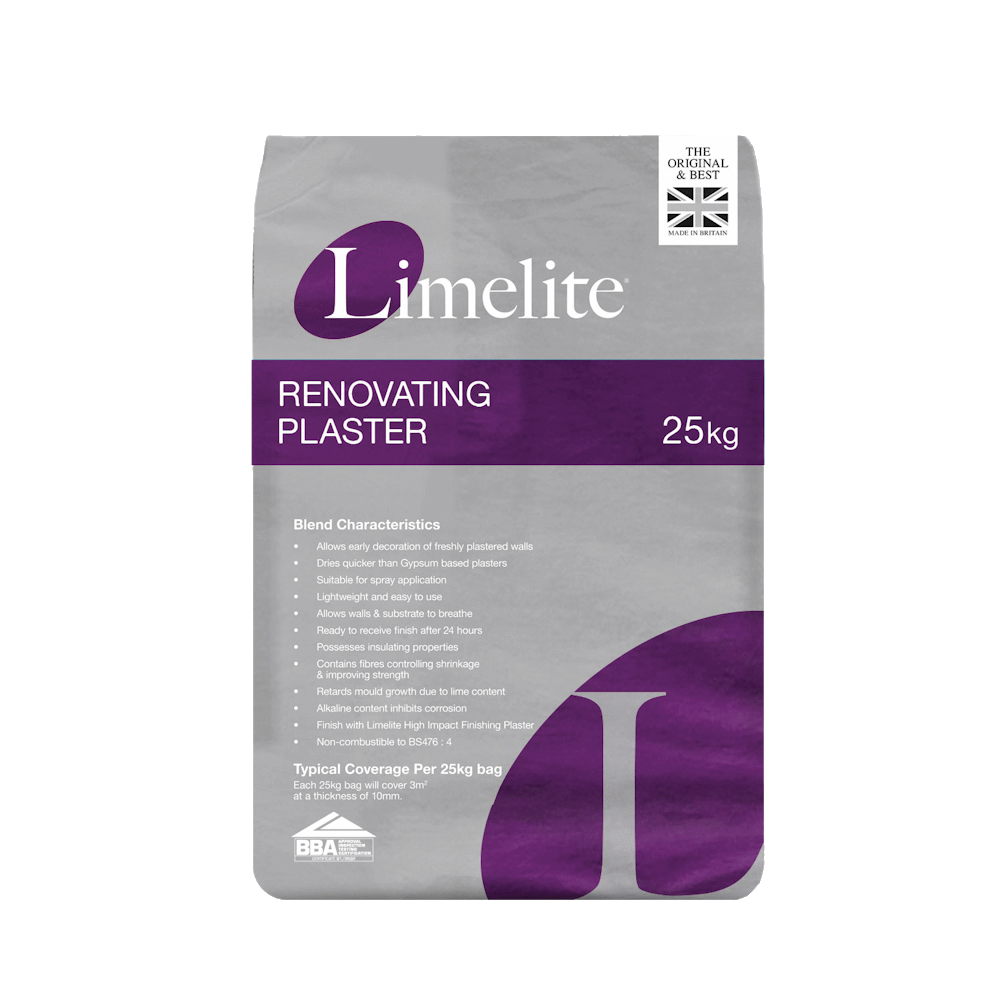
Modern, breathable lime plasters
Limelite offer a range of modern, breathable quick drying lime plasters that are easy to prepare and use. They combine the appearance, breathability and crack resistance of traditional lime plasters with the convenience and efficiency of a modern pre-blended building material. This makes them ideal for renovating, extending or re-purposing older buildings, particularly those made of brick or porous stone.
Coverage and Order Quantities for Limelite plasters
Limelite Easy Bond breathable primer and bond coat. One 5kg tub covers approximately 14-18 m2
Limelite Renovating Plaster can be built up in layers of varying depth.
When applied at 10mm thick, one 25kg bag covers around 3 m2
When applied at 20mm thick, one 25kg bag covers around 1.5 m2
When applied at 30mm thick, one 25kg bag covers around 1 m2
Limelite High Impact Finishing Plaster
When applied as a 2mm finishing coat on 25kg bag covers around 10 m2
Preparing walls for Limelite Renovating Plaster
Substrates should be cleaned and any loose or friable material removed. Any traces of gypsum plaster, bitumen or other materials that could cause a barrier to adhesion must be removed.
Priming the surface before using Limelite Plaster
Once walls have been cleaned and any loose material removed, substrates should be primed with Limelite Easy-Bond and the first coat of plaster should be applied once the priming coat is tacky.
Watch the video
Where to use Limelite plasters?
Limelite plasters are particularly suited for the following applications:
- Older buildings built before 1930
- Private rental and student housing prone to damp and mould
- Solid walled brick or stone buildings used as residential accommodation, offices, hotels, restaurants or as entertainment venues
- Extensions of renovation of older homes with existing lime plaster
- Basement conversions as part of basement lining systems
- Moisture sensitive storage in buildings like museums, galleries or car storage facilities.
- Homes or commercial buildings on flood plains of at risk of flooding
How to mix Limelite Renovating Plaster
It is important to mix Limelite Renovating Plaster thoroughly before use, with a mechanical mixer such as a slow-speed drill and paddle mixer. Fill bucket with approximately 12.5 litres of cool, clean water. Add 25kg of dry powder to the water and mix for 2-3 minutes until a smooth, homogeneous working consistency is achieved. Allow to rest for 3 - 5 minutes, then re-mix back to consistency adding small amounts of water if necessary.
How to use Limelite Renovating Plaster
Once Limelite Easy-Bond Primer is tacky, the first coat of plaster can be applied. Limelite Renovating Plaster should be applied in coats between 7-15mm and a minimum of 24 hours is required between coats. A suitable horizontal scratch should be applied between each coat to provide a key for the next coat.
How to finish walls using Limelite High Impact Finishing Plaster
Once the desired thickness has been achieved Limelite High Impact Finishing Plaster should be applied as a skim coat. Note that gypsum finishing plasters are not suitable for use with Limelite Renovating Plaster. Limelite High Impact Finishing Plaster should be applied in a single coat of between 2-5mm thick. The plaster should be left to set for 90 minutes before using stainless steel trowels to level. Note that Limelite High Impact Finishing Plaster has a matt finish and should not be overworked. Do not polish.
How to decorate when using Limelite breathable plasters
Limelite plasters can be decorated 24 hours after application of Limelite High Impact Finishing Plaster. Paints used must be breathable, such as mineral based or water based paints.
Wall finishes for use with Limelite plasters
Where the breathability needs to be maintained, wallpaper and tiling is not recommended due to the non-porous nature of the finish. However, if wallpaper or tiles is used the moisture content of the plaster must be checked and deemed suitable by the supplier of the decorative finishes before application.
Matching the breathability of traditional mortars
Limelite Mortars are also breathable, allowing moisture to naturally evaporate and reducing the risk of trapped moisture and mould growth.
Limelite plasters are proven to help ambient moisture control in sensitive environments like galleries and museums. They have been chosen for use in moisture sensitive locations such as storage facilities in museums, art galleries and for storage of car collections. However this is also useful for moisture generating applications like gyms, indoor swimming pools or spa facilities. As Limelite are breathable and moisture resistant, they are a popular choice for use with cavity drain membrane systems and tanking systems in converted basements.
Homes, shops, restaurants or commercial buildings in flood risk locations need special consideration when it comes to the choice of plaster. When buildings are flooded it is important that they dry out quickly to allow the occupants to re-enter the building and prevent the growth of moulds.
Limelite Renovating Plaster is breathable so it can be applied directly to damp walls and allows continued release of any moisture absorbed by the walls. It also dries quickly with additional coats applied in as little as 24 hours. This means faster completion and less disruption for residents and business owners.
As Limelite plasters allow moisture to escape, they also help buildings to dry more quickly in the unfortunate event of future flooding, meaning improved future resilience for flood risk properties.
Conversion or barns or other historic buildings needs a high level of expertise and careful choice of building materials. Often existing timber, stone or brick work can be fragile. Preserving these materials along with the character of the original building is vital. Careless use of modern plasters or cement-based mortars or renders can damage existing structures by either trapping in moisture or in the case of cement mortars or renders producing a strong, rigid bond that transfers any stresses from movement in the structure into the weaker brick or stone. Limelite plasters and mortars are designed to complement the look of old buildings but also reflect the breathability and natural movement of traditional lime mortars and plasters.